Zion and Bryce Canyon Tours From Las Vegas
How to combine Zion and Bryce Canyon on a tour from Las Vegas — one-day versus two-day itineraries, what you'll see at each park, the 2026 tunnel restriction, and where to stay between them.
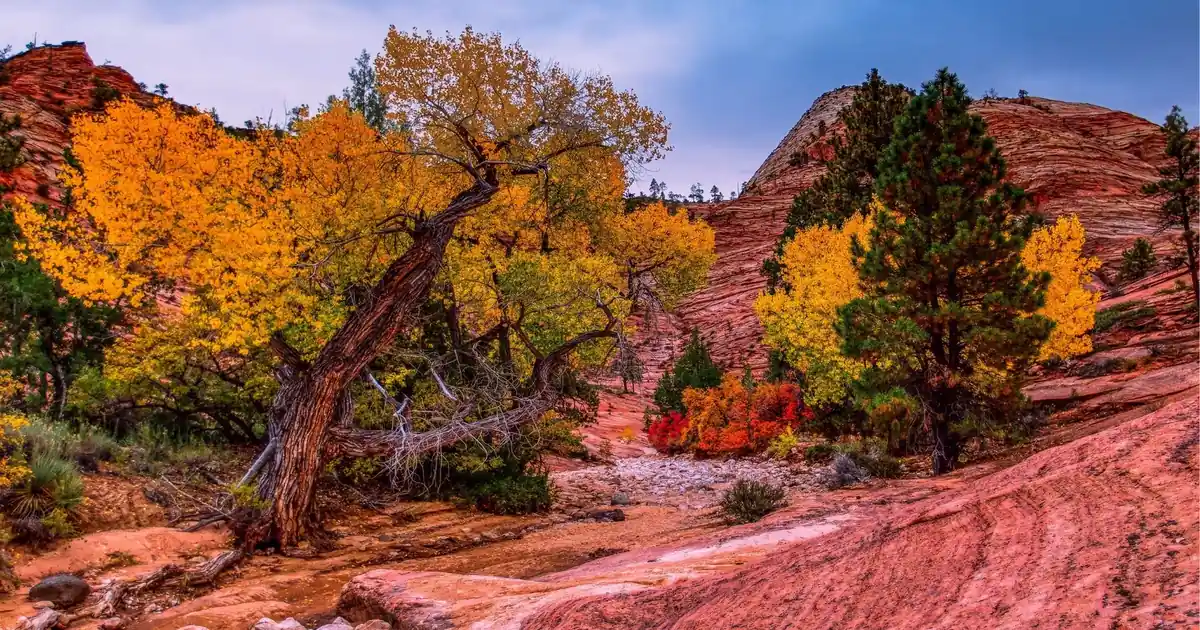
These two parks belong together — they sit about two hours apart and look nothing like each other — but a single day from Las Vegas is a stretch. One-day tours covering both exist and run to roughly thirteen hours, with early-morning departures from the Strip. They work, in the sense that you will stand on the rim at Bryce and walk in Zion Canyon on the same day. They also mean about eight hours in a vehicle and perhaps two hours in each park.
Check Availability
If you have two days, take two days. If you only have one, this page explains what that day actually looks like and how to make the most of it. If you are still deciding which park to prioritise rather than how to book both, Zion vs Bryce Canyon from Las Vegas makes that call instead.
Why pair them at all?
Because they’re opposites, and the contrast is the point.
Zion is a river-carved canyon. You stand at the bottom and look up at 2,000-foot walls of Navajo sandstone with the Virgin River running through it. Park elevations range from about 3,700 feet on the canyon floor to around 9,000 feet on the high plateaus.
Bryce Canyon isn’t a canyon at all. It’s a series of natural amphitheatres eroded into the eastern edge of the Paunsaugunt Plateau, filled with thousands of rock spires called hoodoos. They’re carved not by a river but by freeze-and-thaw: water seeps into cracks in the Claron Formation limestone, freezes overnight, expands, and prises the rock apart. The result glows red, orange and pink, and at Bryce you stand at the top looking down.
There’s a practical consequence too. Bryce’s rim sits between 8,000 and 9,000 feet — the drive from Zion climbs nearly 4,000 feet. It can be snowy and icy at Bryce when Zion’s canyon floor is mild, and it’s noticeably colder year-round. Bring a layer you’d never need in Springdale.
The one-day tour: what it really involves
Several Las Vegas operators sell a both-parks day tour. Expect a departure from a Strip hotel pickup point at around 5.30am and a return around 6 to 7pm — roughly thirteen hours door to door. Better versions include park admissions and handle the shuttle systems at both ends.
A realistic breakdown of that day:
| Segment | Approximate time |
|---|---|
| Las Vegas to Zion | 2.5–3 hours |
| Zion | 2–3 hours |
| Zion to Bryce Canyon | ~2 hours |
| Bryce Canyon | 1.5–2 hours |
| Bryce Canyon back to Las Vegas | 4–4.5 hours |
The return leg is the killer. Bryce is considerably further from Las Vegas than Zion, so you finish the day with a very long drive in the dark. It’s manageable, and thousands of people do it, but go in with your eyes open — this is a coach-window day with two intense bursts of scenery, not a walking holiday.
The default choice is the Bryce and Zion luxury boutique scenic tour with lunch, a thirteen-hour Mercedes Sprinter run at $219 rated 4.7 across more than 1,200 reviews — far and away the most-booked Las Vegas departure that reaches Zion. Read its itinerary carefully before you book: it allocates ninety minutes to Bryce and about forty minutes to Zion, a ten-minute photo stop at Checkerboard Mesa plus half an hour at the Visitor Center. That split is the honest shape of the product, and it suits people who want Bryce with a Zion drive-through rather than the reverse. The Bryce Canyon and Zion Park tour with lunch at $269 is the fifteen-hour alternative, rated 4.6 but across only 20 reviews.
Who it suits: travellers with exactly one free day who would rather see two remarkable landscapes briefly than one at leisure. Photographers and hikers should read the next section instead.
Our full breakdown of the Bryce and Zion scenic day →
The two-day tour: the version that works
Give the same route two days and it transforms. You get an afternoon and a morning in each park instead of a hurried couple of hours, an overnight somewhere between them, and — critically — you’re at Bryce for sunrise or sunset, which is when the hoodoos actually do the thing they’re famous for. Low sun rakes across the amphitheatre and the colour is genuinely startling. Midday light flattens it.
The straight two-day version of this trip is the Zion and Bryce National Park overnight tour at $410, which does exactly the itinerary described above and nothing else. It carries a perfect rating on only five reviews, so book it on the itinerary rather than the score.
Longer itineraries from Las Vegas are widely sold and much better evidenced, usually extending to the Grand Canyon, Antelope Canyon, Horseshoe Bend or Monument Valley. The three-day Grand Canyon, Antelope, Bryce and Zion tour at $590 is the strongest of them — 4.7 across 257 reviews, two hotel nights, and every park entrance fee included, which is unusual at that price. The four-day Grand Canyon, Antelope, Bryce and Zion tour at $860 stretches the same ground over an extra day, rated 4.6 across 44 reviews. Per hour of holiday spent, all of these are far better value than the one-day dash.
One caveat on that list. If Bryce is negotiable, the highest-rated Zion-inclusive departure from Las Vegas is the two-day Grand Canyon, Antelope Canyon, Horseshoe Bend and Zion tour at $350 — 4.9 across 415 reviews, with a hotel night in Page included. It does not go to Bryce Canyon, so it is the wrong answer to the question this page asks; it is the right answer if what you actually want is two days and the best-reviewed itinerary you can get.
The 2026 detail that affects your route
The natural road from Zion to Bryce runs east out of Zion Canyon on the Zion–Mount Carmel Highway, through the 1930 tunnel, and out of the park’s east entrance.
From 7 June 2026, vehicles longer than 35 feet 9 inches, wider than 7 feet 10 inches, taller than 11 feet 4 inches, or heavier than 50,000 pounds are banned from that 10.7-mile stretch between Canyon Junction and the east entrance. Larger vehicles must detour via Kanab or Panguitch, which adds somewhere between 23 and 63 miles to the journey.
What this means for you: on a two-park tour, vehicle size determines your route. A small-group van drives the tunnel, the switchbacks and the slickrock country beyond — one of the best stretches of road in the Southwest, and a highlight in its own right. A large coach takes the long way round and you lose both the scenery and the time.
Ask before booking. On a both-parks itinerary this matters more than on any other Zion tour.
What you’ll see at Bryce Canyon
Tour time at Bryce is short, so it concentrates on the Bryce Amphitheatre, the densest and most photographed section of the park.
Sunset Point and Sunrise Point are the two main viewpoints, half a mile apart on opposite sides of the amphitheatre and linked by a flat, paved, wheelchair-accessible stretch of the Rim Trail. Almost every tour stops at one or both. Inspiration Point and Bryce Point give higher, wider perspectives and are often added if time allows.
If your tour gives you two hours or more, the walk to do is the Queen’s Garden and Navajo Loop — around three miles, moderate, two to three hours, descending from the rim at Sunrise Point into the amphitheatre and climbing back out via the Navajo Loop switchbacks to Sunset Point. It passes Queen Victoria, Thor’s Hammer and Two Bridges, and it’s the difference between looking at hoodoos and walking among them. Sections of the Navajo Loop close seasonally, so check conditions on arrival.
Bryce runs its own free shuttle during the main season, connecting the visitor centre, the amphitheatre viewpoints and lodging outside the park. Unlike Zion, Bryce’s scenic drive stays open to private vehicles, so the shuttle is a convenience rather than a requirement.
Fees: budget for two parks
Standard entry is $35 per vehicle for seven days at each park. If you’re self-driving both, the $80 America the Beautiful annual pass pays for itself immediately — it covers both parks and every other federal recreation site for a year.
Since 1 January 2026, non-US residents aged 16 and over pay an additional $100 per person at both Zion and Bryce Canyon, as part of a surcharge applied at eleven high-demand parks. It’s waived by the $250 America the Beautiful Non-Resident Annual Pass, which covers the holder and all passengers in one non-commercial vehicle — or, for those entering as part of a commercial group, four people.
For international visitors doing both parks, the maths is worth doing carefully: at $100 per person per park visit, the $250 non-resident pass becomes the cheaper option quickly. Most tours include standard US admission but collect the non-resident surcharge separately.
When to go
Late spring and early autumn are the sweet spot for the pairing, because they’re the only seasons that suit both parks at once.
- Summer is comfortable at Bryce, where the elevation keeps things cool — but punishing on Zion’s canyon floor, where temperatures regularly top 100°F (38°C). It’s also the busiest season at both.
- Winter turns Bryce into something extraordinary: snow-dusted hoodoos, very few people. But the rim road can be icy, some trails close, and the drive over from Zion crosses high ground. Zion, meanwhile, is at its quietest and you can drive its scenic road yourself.
- Spring and autumn give you mild conditions in Zion and workable conditions at Bryce, with thinner crowds either side of the summer peak. Mid-September to late October is the strongest single window.
The elevation gap is the thing to plan around: Bryce can be freezing while Zion is pleasant. Pack for both. Our month-by-month guide to visiting Zion from Las Vegas goes through the Zion half of that calculation in more detail.
Staying between the two parks
If you’re driving the route yourself over two or more days, the usual bases are:
- Springdale, at Zion’s south gate — walkable, well-supplied with hotels and restaurants, and connected to the park entrance by a free town shuttle.
- Bryce Canyon City, immediately outside Bryce’s entrance. Ruby’s Inn is the long-established resort complex here, about a mile from the park entrance, with an official Bryce Canyon shuttle stop on the property.
- The Lodge at Bryce Canyon, the historic in-park option, within walking distance of the rim — the choice if catching sunrise over the amphitheatre matters to you.
- Tropic, a few minutes further on, with additional lodging and generally lower rates.
There’s little of use directly between the parks, so pick one end and drive.
Getting between the parks without a car
If you’re travelling car-free, National Park Express runs one-way shuttle segments connecting Las Vegas, St. George, Zion and Bryce. The bookable version is the Las Vegas, Bryce, Zion and St. George shuttle at around $105, run hop-on hop-off with stops that include Ruby’s Inn at Bryce — a Zion-to-Bryce leg of roughly two hours. It is a thin listing at 4.3 stars across 8 reviews, so confirm current timings and pickup points directly with the operator, and treat the rating as indicative.
Otherwise, a two-day guided tour is by some distance the simplest car-free way to combine them. Our car-free guide to reaching Zion from Las Vegas covers the shuttle and bus routes in full.
The verdict
One day, both parks: worth it only if that’s genuinely all the time you have, and only if you’re comfortable with a thirteen-hour day mostly spent moving. You’ll get the contrast, which is the main prize.
Two days: the right shape for this trip. Sunrise or sunset at Bryce alone justifies the extra day, and Zion stops feeling like a coach stop.
One day, one park: if you’re choosing, most first-time visitors should choose Zion — it’s closer, it’s more varied, and the shorter drive buys you meaningfully more time on the ground. What a Zion-only day actually delivers →
If you want the six Las Vegas departures set side by side on price, group size and time in each park, start with which Zion tour from Las Vegas is right for you.
Frequently asked questions
How far is Bryce Canyon from Zion National Park?
About two hours by road, climbing nearly 4,000 feet. Bryce’s rim sits between 8,000 and 9,000 feet, so conditions can be markedly colder and snowier than in Zion Canyon.
Can you do Zion and Bryce Canyon in one day from Las Vegas?
Yes, on a guided tour of roughly thirteen hours with an early-morning start. You’ll get around two to three hours in Zion and one and a half to two in Bryce, with about eight hours of driving in total.
Which is better, Zion or Bryce Canyon?
They’re too different to rank. Zion is a river-carved canyon you walk through from the bottom; Bryce is a set of hoodoo amphitheatres you look down into from the rim. If you can only do one from Las Vegas, Zion is closer and gives you more time on the ground.
How much does it cost to enter both parks?
Standard entry is $35 per vehicle at each, or $80 for the America the Beautiful annual pass covering both. Non-US residents aged 16 and over pay an extra $100 per person at each park in 2026 unless they hold the $250 non-resident annual pass.
What’s the best hike at Bryce Canyon on a short visit?
The Queen’s Garden and Navajo Loop combination — about three miles, moderate, two to three hours, dropping from the rim into the amphitheatre and back. Check for seasonal closures on the Navajo Loop before setting off.
Do you need a shuttle at Bryce Canyon?
No. Unlike Zion, Bryce’s scenic drive remains open to private vehicles, and its free seasonal shuttle is a convenience rather than a requirement.
When is the best time to visit Bryce and Zion together?
Late spring or early autumn, with mid-September to late October the strongest window. Summer is hot in Zion; winter can bring snow and ice to Bryce’s rim.
Where should you stay between Zion and Bryce Canyon?
There’s little worth stopping for in between. Base yourself in Springdale for Zion, or in Bryce Canyon City or Tropic for Bryce, and drive the two-hour link.
See Zion Without Driving 320 Miles Yourself
Hotel pickup on the Strip, a small group capped at 13, two guided trails and lunch in the canyon. Free cancellation up to 24 hours before departure.
Check Availability & Book