The Zion Canyon Shuttle
How Zion's free canyon shuttle works in 2026 — all nine stops, the seasonal timetable, the two different last-bus times that catch people out, and when you can drive the scenic road yourself.
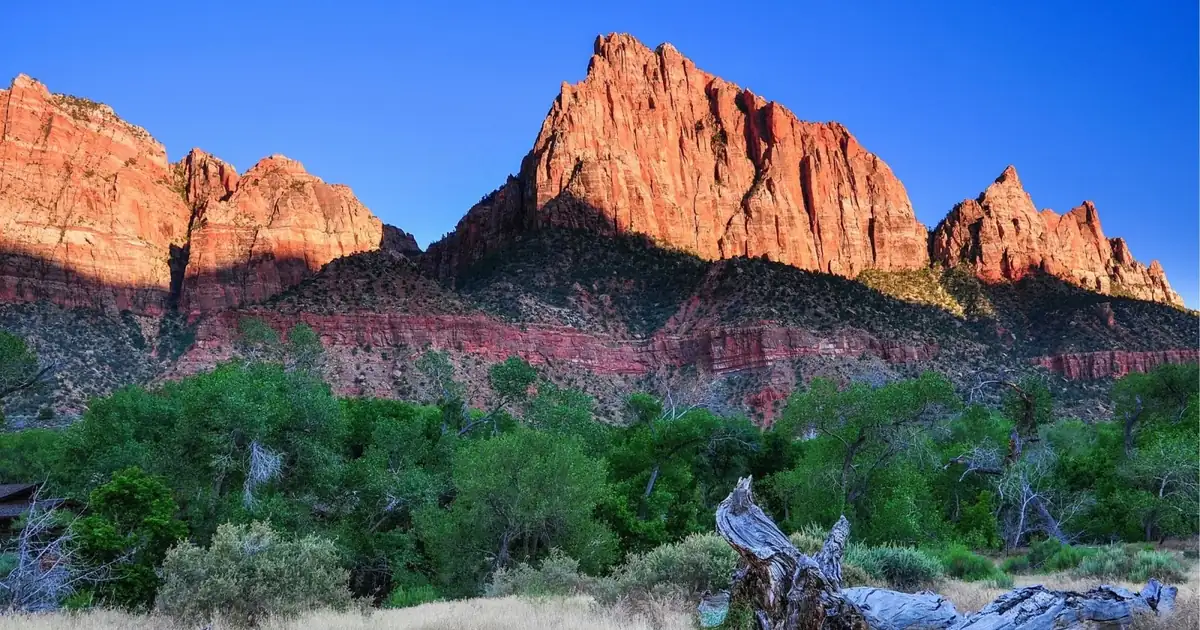
For most of the year the shuttle is the only way up Zion Canyon. It is free, it needs no ticket and no reservation, and you cannot drive the scenic road instead. Understanding it is the difference between a smooth day in Zion and a frustrating one.
Check Availability
There are two shuttle lines: the Zion Canyon Line, which runs inside the park from the visitor centre to Temple of Sinawava, and the Springdale Line, which runs through the gateway town to the park’s pedestrian entrance. Both are free. This page covers both, all nine in-park stops, and the one scheduling detail that strands people every season.
The essentials
- Free to ride. No ticket, no reservation, no booking. You do still need to pay park entry.
- Nine stops on the Zion Canyon Line, from the visitor centre (stop 1) to Temple of Sinawava (stop 9).
- Runs 7 March to 28 November 2026, with no service from 29 November to 25 December and a short holiday timetable from 26 December to 2 January.
- Private vehicles are barred from Zion Canyon Scenic Drive throughout the shuttle season.
- About 40 to 45 minutes each way, so a round trip without getting off takes roughly an hour and a half.
- Frequency: every 5 to 10 minutes on the canyon line, every 10 to 15 on the Springdale line.
The detail that catches people out
There are two different “last shuttle” times, and they are not the same number.
The last bus that leaves the visitor centre heading up the canyon is an hour and a quarter earlier than the last bus that leaves Temple of Sinawava heading back down. That makes sense — the final downhill bus has to sweep the canyon after the last uphill one has run. But it means a single “last shuttle” figure quoted on a travel blog is close to useless, because it does not say which direction it applies to.
What matters to you is the last departure from Temple of Sinawava, or from whichever stop you are furthest from, because that is the bus that gets you home. Both figures are in the table below.
Practical rule: note the last departure from the stop you will be furthest from, and work backwards from it with an hour to spare. The park’s own advice is blunter than most travel writing on the subject: do not wait for the last shuttle of the day, because if it is full or you miss it, you may be walking the nine miles back to the visitor centre.
Zion Canyon Line: the nine stops
| Stop | Name | Why get off |
|---|---|---|
| 1 | Zion Canyon Visitor Center | Start here. Ranger desk, current conditions board, water, toilets |
| 2 | Zion Human History Museum | Orientation film and a good view up-canyon to the Towers of the Virgin |
| 3 | Canyon Junction | Where the scenic drive meets the Zion–Mount Carmel Highway; Pa’rus Trail access |
| 4 | Court of the Patriarchs | A paved path about 150 feet long to a viewpoint over three sandstone peaks. Two minutes, high reward |
| 5 | Zion Lodge | The only in-park accommodation. Food, toilets, gift shop and a lawn. Trailhead for the Lower Emerald Pools Trail and the horse corral |
| 6 | The Grotto | Trailhead for Angels Landing and the Kayenta Trail to Emerald Pools |
| 7 | Weeping Rock | Short steep path to a dripping alcove with hanging gardens |
| 8 | Big Bend | Where the walls close in. Classic view of the Great White Throne and Angels Landing from below |
| 9 | Temple of Sinawava | End of the road. Riverside Walk and the entrance to the Narrows |
One boarding rule that surprises people: you cannot board a shuttle heading up the canyon at Canyon Junction (stop 3) or the Human History Museum (stop 2). Both take southbound passengers only, so plan to start from the visitor centre.
Stop 7: Weeping Rock and its shuttle stop were closed for nearly two years after a rockfall in November 2023, and reopened on 5 September 2025. A surprising number of travel pages still list it as closed.
Stop 6: the Angels Landing chain section beyond Scout Lookout needs a lottery permit, year-round, and the park does not issue permits for same-day hikes. The Grotto is also the trailhead for gentler walks, so getting off here commits you to nothing strenuous.
See also: the Zion Narrows, a complete guide.
Seasonal schedule
These are the National Park Service’s published times for the 2026 season. The park adjusts them every year and occasionally mid-season, so confirm against the NPS schedule for your own travel dates.
Zion Canyon Line (inside the park):
| Period | First up from visitor centre | Last up from visitor centre | Last down from Temple of Sinawava |
|---|---|---|---|
| 17 May – 12 September | 7.00am | 7.00pm | 8.15pm |
| 13 September – 24 October | 7.00am | 6.00pm | 7.15pm |
| 25 October – 28 November | 7.00am | 5.00pm | 6.15pm |
| 29 November – 25 December | No service | — | — |
| 26 December – 2 January | 8.00am | 4.30pm | 5.45pm |
Springdale Line (the town shuttle):
| Period | First | Last |
|---|---|---|
| 17 May – 12 September | 8.00am | 8.00pm |
| 13 September – 24 October | 8.00am | 7.00pm |
| 25 October – 28 November | 8.00am | 6.00pm |
| 29 November – 25 December | No service | — |
| 26 December – 2 January | 8.00am | 6.00pm |
The gap between the two right-hand columns in the first table is the thing to carry away: in high summer the last bus up leaves at 7.00pm and the last bus down at 8.15pm, and in late autumn those become 5.00pm and 6.15pm.
The Springdale Line
The town shuttle runs the length of Springdale’s main street with nine stops, covering under three miles. Numbering runs the opposite way to what most visitors assume: Zion Canyon Village, immediately next to the park’s pedestrian entrance, is stop 1, and the Hotel De Novo at the far end of town is stop 9.
How the two lines connect: the Springdale Line drops you at the pedestrian entrance. You walk across the bridge into the park, pay or show your entry pass, and pick up the Zion Canyon Line at the visitor centre. They are separate systems with a short walk between them, not a single through route.
If you are staying in Springdale, this is how you should get to the park. It removes the parking problem entirely, which is the single biggest source of wasted time at Zion.
See also: getting to Zion from Las Vegas without a car.
When can you drive the scenic road yourself?
In the off-season — roughly early January to early March, and from late November until shortly before Christmas. When the shuttle is not running, Zion Canyon Scenic Drive reopens to private vehicles, and the character of a visit changes completely: you drive from viewpoint to viewpoint at your own pace, stop where you like, and stay for the light.
This is the strongest argument for a winter visit to Zion, and it is badly under-appreciated.
Two caveats. Parking at trailheads along the drive is very limited, and the park will temporarily close the scenic drive when the lots fill — so an early start still matters. And winter brings ice on trails and the possibility of weather-related delays.
During shuttle season there is one exception: guests staying at Zion Lodge may drive to the lodge and board the shuttle there. Everyone else parks at the visitor centre or in Springdale.
Parking, and how to avoid needing it
The visitor centre car park routinely fills early in the day in peak season — the park says so itself. Once it is full, you are looking for paid parking in Springdale and riding the town shuttle in, which works, but costs you time and money you needn’t have spent.
The options, best first:
- Stay in Springdale and use the town shuttle. No parking, no stress.
- Arrive early. Be at the visitor centre before the crowds and take the first canyon shuttle at 7am.
- Park in Springdale and ride in. Paid lots along the main street, connected by the free town shuttle.
- Use the Virgin park-and-ride. Launched 1 March 2026 in the town of Virgin, $5 one way, with a small number of free spaces including some sized for oversized vehicles. First come, first served, no overnight parking.
- Arrive in the afternoon. Counter-intuitive, but spaces open from mid-afternoon as morning visitors leave — and the canyon light is better late anyway.
The other way to sidestep all of it is to let somebody else drive. A guided day trip from Las Vegas handles the gate, the car park and the shuttle as part of the day, which is why the parking question never comes up on one.
Other ways up the canyon
Bicycles are permitted on the scenic drive year-round, including during shuttle season — one of the few ways to travel the canyon under your own power when cars are barred. Each shuttle bus carries a rack for three bikes, so you can ride one way and take the bus back. E-bikes are not allowed on the shuttle or on the bike racks, which is worth knowing before you hire one in Springdale. Cyclists must pull over and stop for passing shuttles.
Walking the Pa’rus Trail from the visitor centre to Canyon Junction is paved, flat and pleasant, and avoids the shuttle for the first stretch.
Accessibility
Shuttle buses are accessible, and the park publishes specific guidance for visitors who cannot use them. If mobility is a concern, contact the park directly before your visit instead of relying on third-party information — arrangements for vehicle access during shuttle season are handled case by case.
Frequently asked questions
Do you need a ticket for the Zion shuttle?
No. Both the Zion Canyon Line and the Springdale Line are free, with no ticket, permit or reservation required. You do need to pay park entry to get into Zion itself.
What time does the first Zion shuttle run?
The first bus up the canyon from the visitor centre leaves at 7.00am through the main season, and at 8.00am during the holiday service from 26 December to 2 January. The Springdale town shuttle starts at 8.00am year-round.
What time is the last shuttle out of Zion Canyon?
It depends on the season, and it is a different time from the last bus up the canyon. The last departure from Temple of Sinawava is 8.15pm from 17 May to 12 September, 7.15pm from 13 September to 24 October, and 6.15pm from 25 October to 28 November. The park advises against relying on it, because it may be full.
How long does the Zion shuttle take?
About 40 to 45 minutes from the visitor centre to Temple of Sinawava, so a full round trip without getting off takes roughly an hour and a half. Buses run every 5 to 10 minutes in high season, which makes hopping on and off straightforward, though each stop costs you queueing time.
Can you drive in Zion National Park instead of taking the shuttle?
Not up Zion Canyon during shuttle season, which runs 7 March to 28 November 2026. Other park roads, including the Zion–Mount Carmel Highway, the Kolob Terrace Road and the Kolob Canyons Scenic Drive, stay open to private vehicles year-round. The canyon road reopens to cars in the off-season.
How many stops are on the Zion shuttle?
Nine on the Zion Canyon Line, from the visitor centre (stop 1) to Temple of Sinawava (stop 9). The Springdale town shuttle also has nine stops.
Which shuttle stop is the Narrows?
Stop 9, Temple of Sinawava — the last one. From there you walk the paved Riverside Walk about a mile before the river becomes the trail.
Which shuttle stop is Angels Landing?
Stop 6, The Grotto. The chain section beyond Scout Lookout requires a lottery permit, and the park does not issue them for same-day hikes.
Is the Zion shuttle running in winter?
It pauses from 29 November to 25 December and again after 2 January until the spring start, which is when private vehicles may use the scenic drive. A reduced holiday service runs from 26 December to 2 January.
Can you take a bike on the Zion Canyon road?
Yes. Bicycles are allowed on the scenic drive year-round, including when cars are barred, and each shuttle bus has a rack for three of them. E-bikes are allowed on the road but not on the buses or their racks. Cyclists must stop and let shuttles pass.
See Zion Without Driving 320 Miles Yourself
Hotel pickup on the Strip, a small group capped at 13, two guided trails and lunch in the canyon. Free cancellation up to 24 hours before departure.
Check Availability & Book