Zion Entrance Fees and Passes
Zion National Park entry costs $35 per vehicle in 2026, plus a $100 per-person surcharge for non-US residents. The full fee schedule, every pass option, fee-free days and what entry doesn't cover.
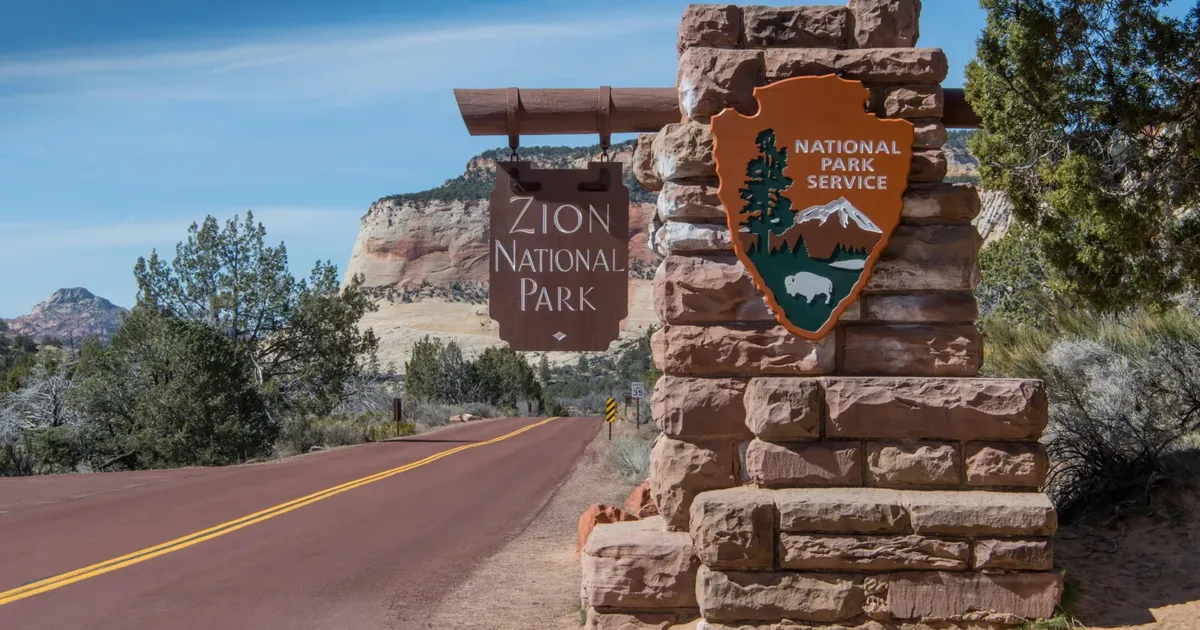
Entry to Zion National Park costs $35 per private vehicle, valid for seven days. Children aged 15 and under are free. And since 1 January 2026, every non-US resident aged 16 or over pays an additional $100 per person on top of that.
Check Availability
That surcharge is the biggest change to the cost of visiting Zion in years, and there is a way round it that is easy to miss: any valid America the Beautiful pass, including a US resident’s $80 one, covers the surcharge for everyone in the pass holder’s private vehicle. Details below.
No reservation or timed-entry ticket is required to enter Zion. You pay at the gate or show a pass, and you drive in.
Last checked: 30 September 2026. Park fees changed substantially in 2026 and the non-resident policy is subject to an unresolved legal challenge. Check the National Park Service fees page before you travel.
Standard entrance fees
| What you’re paying for | Cost | Valid for |
|---|---|---|
| Private vehicle (capacity 15 or fewer, all occupants) | $35 | Up to 7 days |
| Motorcycle (up to 2 motorcycles, max 4 riders) | $30 | 7 days |
| Per person on foot or by bicycle, aged 16+ | $20 | Up to 7 days |
| Youth aged 15 and under | Free | — |
| Zion Annual Pass (Zion only) | $70 | 12 months from month of purchase |
| America the Beautiful Annual Pass (all federal sites) | $80 | 12 months |
Non-commercial groups arriving in a vehicle with capacity for 16 or more pay the $20 per-person rate, capped at the commercial rate for a vehicle of that size.
A few practical points. You don’t need to display your pass, but you must be able to show it to re-enter, including if you park in Springdale and walk back in through the pedestrian entrance. Passes are non-transferable, and a lost pass has to be bought again. The Zion Annual Pass is sold in person at entrance stations only, and is available to US citizens and residents.
Kolob Canyons, the separate district in the park’s north-west corner off I-15, is part of Zion National Park. The park’s fee page does not mention it by name, so keep your receipt or pass with you if you plan to drive there on the same trip.
The $100 non-resident surcharge
This is the part to read carefully if you’re visiting from outside the United States.
Since 1 January 2026, non-US residents aged 16 and over pay $100 per person, in addition to the standard entrance fee, at eleven high-demand national parks. The National Park Service describes it plainly as a per-person fee.
The eleven parks it applies to
Acadia · Bryce Canyon · Everglades · Glacier · Grand Canyon · Grand Teton · Rocky Mountain · Sequoia & Kings Canyon · Yellowstone · Yosemite · Zion
Note what’s not on the list: Arches and Canyonlands, Utah’s other big two, are unaffected.
It is charged separately at each park. That matters for the classic Southwest itinerary: a Zion and Bryce Canyon trip means $200 per adult in surcharges alone if you aren’t covered by a pass.
Children are exempt
Anyone aged 15 or under pays neither the entrance fee nor the surcharge.
Where it comes from
The surcharge stems from Executive Order 14314, “Making America Beautiful Again by Improving Our National Parks,” signed on 3 July 2025 and published in the Federal Register on 9 July 2025. The Department of the Interior announced the specific figures on 25 November 2025.
How long does it last?
The Park Service has not said, and we won’t guess. The standard entrance fee is valid for seven days. The National Park Service has not published whether the $100 surcharge carries the same seven-day validity and re-entry rights. Some secondary sources say it does; some tour operators describe it as payable per park entry.
If you plan to leave and re-enter Zion across several days, ask at the entrance station when you pay and keep your receipt. Don’t assume either way.
The pass that changes the maths
Every valid America the Beautiful pass, and the Zion Annual Pass, covers both entrance fees and non-resident fees for the pass holder and their passengers in a private vehicle. The National Park Service is explicit about this, and it applies regardless of which year the pass was issued. Passes bought before January 2026 are honoured on their original terms.
What this means in practice:
- A non-US resident travelling in a private vehicle with a friend or relative who holds an $80 America the Beautiful pass pays no surcharge at all.
- The same applies to a vehicle covered by a Senior, Military, Access, 4th Grade or Volunteer pass.
- It applies to the $70 Zion Annual Pass too.
If you’re an international visitor being driven by a US-resident host who already has a pass, you may owe nothing beyond what the pass covers. Some third-party sites state the opposite; the Park Service’s own guidance is the authority here.
The $250 Non-Resident Annual Pass
For international visitors not covered by someone else’s pass, this is the main alternative to paying $100 per park.
- Price: $250. Valid 12 months, from the purchase date to the end of that month in the following year.
- In a private vehicle: covers the entire vehicle, meaning all passengers’ entrance fees and surcharges, or two motorcycles.
- On a commercial tour, or entering per person: covers the holder plus three additional adults aged 16 or over. That’s four people, not the whole coach.
- One named holder, who must be present with matching photo ID.
- Anyone may buy it, though it’s intended for non-residents.
- It does not cover camping, permits or other amenity fees.
Is it worth it?
| Your situation | Cheaper option |
|---|---|
| International solo traveller, Zion only | $35 + $100 = $135. Skip the pass |
| International couple, Zion only | $35 + $200 = $235. Marginal — skip it unless plans might grow |
| International couple, Zion + Bryce | $70 + $400 = $470. Buy the $250 pass |
| International visitor, Zion + Bryce + Grand Canyon | Three surcharges each. Buy the $250 pass |
| Four international adults on a Las Vegas tour | One $250 pass covers all four. Buy it — works out around $62.50 each |
| US visitor, one Zion trip | $35 standard vehicle pass |
| US visitor, two or more parks this year | $80 America the Beautiful pass |
| US visitor aged 62+ | $80 Senior Lifetime pass — covers you for good |
Buy digital, not physical. A digital pass from Recreation.gov works immediately. A physical pass ordered from the USGS store can take up to three weeks to arrive. If you’re travelling soon, buy digitally or buy at the gate.
All the pass options
| Pass | Price | Who’s eligible | Covers the $100 surcharge? |
|---|---|---|---|
| America the Beautiful Annual (Resident) | $80 | US citizens and residents | Yes — for everyone in the holder’s private vehicle |
| America the Beautiful Annual (Non-Resident) | $250 | Anyone; intended for non-residents | Yes |
| Senior Annual | $20 | US citizens/permanent residents 62+ | Yes |
| Senior Lifetime | $80 | US citizens/permanent residents 62+ | Yes |
| Military Annual | Free | Current US military and dependents | Yes |
| Military Lifetime | Free | Veterans and Gold Star families | Yes |
| Access Pass | Free | US citizens/residents with permanent disability | Yes |
| Every Kid Outdoors (4th Grade) | Free | US fourth-graders | Yes |
| Volunteer Pass | Free | 250 federal volunteer hours | Yes |
| Zion Annual Pass | $70 | US citizens and residents | Yes |
Each pass has one named holder who must show photo ID when using it. All are non-refundable, non-transferable, and cannot be replaced if lost or stolen. Senior passes require proof of age and residency and cannot be bought as gifts.
Proof of US residency
If you’re claiming the resident rate, bring one of these:
- A US passport
- A US state or territory driver’s licence or ID card
- A Permanent Resident Card (green card)
US citizens living abroad: your US passport qualifies you for the resident rate. There’s no separate test of where you actually live.
Green card holders: exempt from the surcharge.
Dual nationals: show your US passport. A foreign passport alone will be treated as non-resident.
Foreign nationals living in the US on a visa: this is a grey area. A US state driver’s licence is on the accepted list, but the Park Service hasn’t addressed this group directly. Bring your state ID and be prepared for a conversation.
Fee-free days in 2026
The 2026 calendar listed eight fee-free dates, one of them the three-day Independence Day weekend. Two remain: 27 October (Theodore Roosevelt’s birthday) and 11 November (Veterans Day). Martin Luther King Jr. Day and Juneteenth are not on the 2026 list.
Two important caveats:
- Fee-free days apply to US citizens and residents only. Non-residents still pay the standard entrance fee and the $100 surcharge on these dates. One Park Service page still carries older wording about free admission “to everyone”; the Zion fees page and the non-resident guidance are unambiguous that it’s residents only.
- Only entrance fees are waived. Camping, wilderness permits and the Angels Landing lottery are all still charged.
2027 dates have not been announced.
What your entry fee does not cover
Angels Landing permit
A permit is required around the clock for the chain section beyond Scout Lookout.
- $6 application fee, non-refundable, covering up to six people
- $3 per person if you’re awarded a permit
- Two lotteries: a seasonal lottery one to three months ahead using ranked date choices, and a day-before lottery you apply to by 3pm Mountain Time
- Cancelled seasonal permits roll into the day-before lottery
- You still pay park entry on top
Wilderness and canyoneering permits
- Day use, including technical canyons, the Subway, and the Narrows top-down day hike from Chamberlain’s Ranch: $6 lottery or reservation fee plus $10 per person
- Overnight, including a one-night Narrows through-hike: $20 per permit plus $7 per person per night
- Permits must be collected in person at the Wilderness Desk in the Zion Canyon Visitor Center
The bottom-up Narrows day hike from Temple of Sinawava needs no permit and costs nothing beyond park entry. Note that the top-down route has a stricter closure threshold than the bottom-up one: top-down permits are withdrawn above 120 cubic feet per second, while the park closes the Narrows to all travel above 150 CFS.
See also: the Zion Narrows, a complete guide.
Camping
Watchman Campground runs around $45 a night for electric sites and $35 non-electric; South Campground, which reopened on 29 May 2026 after rehabilitation, around $35; and Lava Point around $25. Senior and Access pass holders get 50% off one site. Confirm current rates on Recreation.gov, because these figures date from an earlier rate schedule.
Things that are free
- The Zion Canyon shuttle. No ticket, no reservation, no charge.
- The Springdale town shuttle. Also free.
The separate SunTran Zion Route bus from St. George is a paid public service at $5 one way, useful, but not a park shuttle.
See also: the Zion Canyon shuttle: schedule, stops and how it works.
One charge that no longer exists
The $15 oversized-vehicle escort permit for the Zion–Mount Carmel Tunnel has been discontinued. From 7 June 2026, vehicles over 35 feet 9 inches long, 7 feet 10 inches wide, 11 feet 4 inches tall, or 50,000 pounds are barred from that stretch of highway altogether, and tunnel permits are no longer issued. One Park Service page still lists the old fee; it’s out of date.
Small extras
A $5 dump station fee applies at Watchman for non-campers. And if you’re on a tour and leave the park on foot into Springdale, make sure your driver has given you a re-entry sticker. Without one you’ll be charged the $20 per-person fee again.
If you’re visiting on a tour from Las Vegas
Standard park entry is usually included in the tour price. Operators pay a commercial fee based on the vehicle’s seating capacity, not on how many people are aboard: $70 for a van of 7 to 15 seats, $80 for a mini-bus of 16 to 25 and $190 for a coach of 26 or more. It is built into what you pay.
The $100 surcharge is almost always separate, and paid by you. Operators handle it in several different ways: some collect it at the start of the tour, some contact you in advance, some have guides collect it on the day, and some simply tell you it isn’t included and leave you to arrange it. Most ask US residents to show ID at check-in.
Here is how four of the Las Vegas departures we cover set it out on their own listings:
| Tour | US residents | Non-US residents |
|---|---|---|
| Zion small-group day trip with lunch ($138, 4.7/5 from 98 reviews) | Park admission included | Surcharge not included; pay it at the park or show a $250 non-resident pass |
| Bryce and Zion scenic day tour ($219, 4.7/5 from more than 1,200 reviews) | Park admission included | Surcharge for both parks excluded; the listing offers the $250 pass or $100 per adult per park |
| Three-day Grand Canyon, Antelope, Bryce and Zion tour ($590, 4.7/5 from 257 reviews) | Every park entrance listed as included | Check whether the surcharge applies to your booking before you pay |
| Three-day Grand Canyon, Zion and Monument Valley tour ($875, 4.8/5 from 284 reviews) | Park fees covered for US residents only | Non-resident park fees listed as excluded |
Two things to do before booking:
- Ask the operator directly how they handle the surcharge, and whether they can sell you a Non-Resident Annual Pass, as some can.
- If there are three or four international adults in your party, buy one $250 pass. It covers the holder plus three other adults on a commercial tour, and pays for itself immediately on a two-park itinerary.
See also: Zion National Park tours from Las Vegas: every option compared.
Compare all six Las Vegas departures, most with standard park entry included →
Could the fees change again?
Possibly, and it’s worth knowing before you plan around them.
The non-resident fee structure is the subject of an unresolved lawsuit in the US District Court for the District of Columbia, filed in December 2025, which among other things challenges whether the resident and non-resident pass categories are lawful under existing federal recreation-fee legislation. As of late September 2026 no ruling or injunction has been issued. Conservation groups and a number of senators have publicly asked the Interior Department to pause the policy; separate bills that would write the surcharge into law, and a draft bill that would raise pass prices from January 2027, have been introduced but not enacted.
What this means for you: nothing has changed yet, and the fees above are what you’ll pay today. But if you’re booking a long way ahead, re-check before you travel. No 2027 fee schedule, pass prices or fee-free days have been announced.
Frequently asked questions
How much does it cost to enter Zion National Park?
$35 per private vehicle for up to seven days, $30 for a motorcycle, or $20 per person on foot or by bicycle. Children aged 15 and under enter free. Non-US residents aged 16 and over pay an additional $100 per person.
Do you need tickets or a reservation for Zion National Park?
No. Zion has no timed-entry or vehicle reservation system. You pay at the entrance station or show a valid pass. The only advance permits are for Angels Landing, wilderness routes and camping.
What is the $100 Zion fee for international visitors?
Since 1 January 2026, non-US residents aged 16 and over pay a $100 per-person surcharge on top of standard entry, at Zion and ten other high-demand national parks. It’s charged separately at each park, and waived if you’re covered by a valid America the Beautiful pass.
Can a US resident’s park pass cover an international visitor?
Yes, in a private vehicle. The Park Service states that all valid America the Beautiful and park-specific annual passes cover both entrance and non-resident fees for the holder and their passengers in a private vehicle. On a commercial tour, a pass covers the holder plus three other adults.
Is the $250 non-resident pass worth buying?
If you’re visiting two or more of the eleven surcharge parks, or travelling with two or more other adults, yes, comfortably. For a single international traveller visiting only Zion, paying the $35 plus $100 is cheaper.
How long is a Zion entrance pass valid?
Standard entrance passes are valid for up to seven days. The Park Service has not confirmed whether the $100 non-resident surcharge carries the same seven-day validity, so ask at the gate if you plan to re-enter.
Is the Zion shuttle included in the entrance fee?
The shuttle is free and needs no ticket, but you do need to have paid park entry to be in the park at all.
Are there free entry days at Zion?
Yes, but they apply to US citizens and residents only; non-residents still pay entry and the $100 surcharge. Two remain in 2026: 27 October and 11 November. The 2027 calendar hasn’t been published.
Does the entrance fee include Kolob Canyons?
Kolob Canyons, off I-15 with its own entrance and visitor centre, is part of Zion National Park. The park’s fee page does not name it separately, so keep your pass or receipt with you if you drive there on the same trip.
Do Las Vegas tours include the Zion entrance fee?
Most include standard park entry, because operators pay a commercial vehicle fee and build it into the price. The $100 non-resident surcharge is almost always charged separately. Confirm both with the operator before booking.
What’s the cheapest way to visit Zion?
For US visitors: arrive on foot or by bike for $20 per person, or share a vehicle for $35. For international visitors travelling with a US-resident pass holder in a private vehicle, the pass covers you. Otherwise the $250 annual pass is the lever if you’re visiting more than one surcharge park.
See Zion Without Driving 320 Miles Yourself
Hotel pickup on the Strip, a small group capped at 13, two guided trails and lunch in the canyon. Free cancellation up to 24 hours before departure.
Check Availability & Book