The Zion Narrows
How to hike the Zion Narrows — the no-permit bottom-up day hike from Temple of Sinawava, the 16-mile top-down route, river levels, gear, flash flood rules, and why no Las Vegas day trip gets you there.
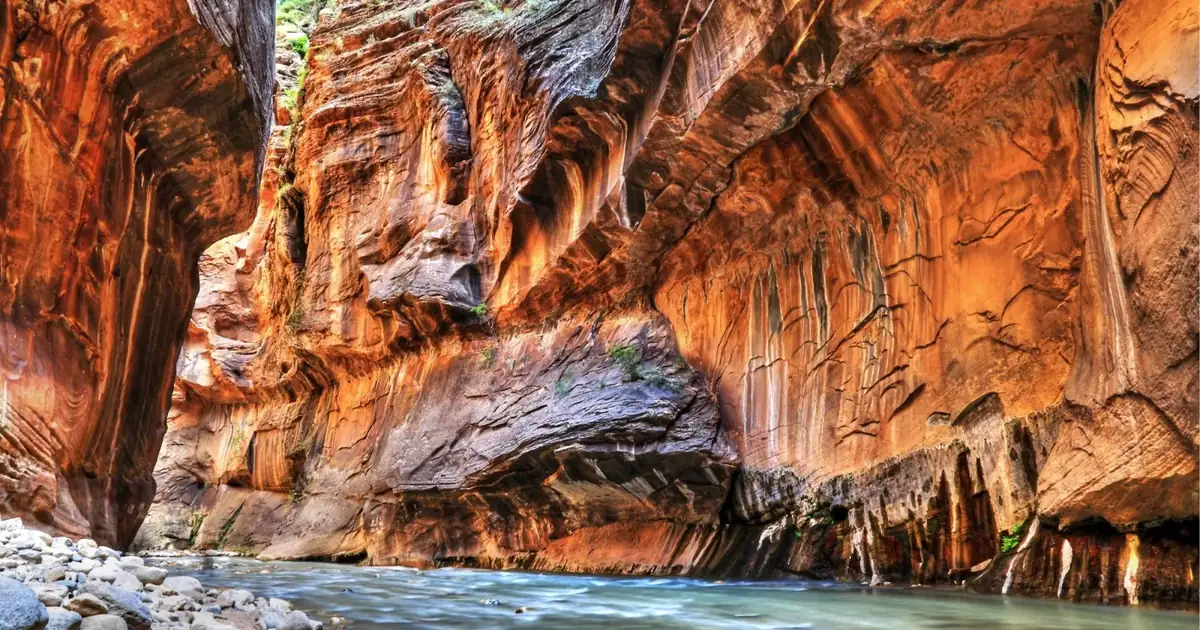
The Narrows is the stretch of Zion Canyon where the walls close in and the Virgin River becomes the trail. There is no path. You walk in the river, on cobbles the National Park Service compares to wet bowling balls, between sandstone walls that in places stand only 20 to 30 feet apart and rise as much as 2,000 feet above you.
Check Availability
Two pieces of good news. You need no permit for the popular bottom-up day hike, and you need no particular hiking pedigree either — plenty of people wade in for an hour and come away thrilled. The bad news, if you are reading this from a Las Vegas hotel, is that no day trip from the Strip gets you here. That is covered properly below.
What the Narrows actually is
Zion Canyon is a quarter to half a mile wide where most visitors see it. Upstream of Temple of Sinawava it tightens dramatically, and the park’s own canyon narration puts the tightest sections at 20 to 30 feet across with 2,000 feet of rock above them. A corridor narrower than a suburban street, walled by something taller than most skyscrapers, is what makes the place feel the way it does.
The Virgin River carved it and still occupies it. There is no dry route through, and the riverbed is loose, uneven rock underfoot.
How deep you get depends on the flow, and the park publishes the bands:
| River flow | What the walking is like |
|---|---|
| Below 70 CFS | Moderately difficult. Knee-deep crossings, frequent pools up to waist-deep |
| 70–150 CFS | Challenging against the current. Thigh-deep crossings are frequent, pools can be chest-deep |
| Above 150 CFS | Closed to all travel |
The canyon runs roughly sixteen miles from Chamberlain’s Ranch, at about 5,900 feet on the plateau above, down to Temple of Sinawava on the canyon floor. Which end you start from defines everything about your day.
Bottom-up or top-down?
| Bottom-up | Top-down | |
|---|---|---|
| Start | Temple of Sinawava (shuttle stop 9) | Chamberlain’s Ranch |
| Distance | Up to a 10-mile round trip | 16 miles, one way |
| Permit | None required | Wilderness permit required |
| Transport | Park shuttle | Self-arranged shuttle to the trailhead |
| Time | 1 hour to a full day — your choice | Long single day, or two days with a camp |
| Direction | Upstream, against the current | Downstream, with the current |
| Suits | Almost everyone | Experienced, prepared hikers |
The bottom-up day hike — what almost everyone does
You ride the park shuttle to Temple of Sinawava, the last stop, and walk the paved, near-level Riverside Walk about a mile upriver. Where the pavement ends, the river begins, and so does the Narrows.
The best thing about this hike is that you choose its length. As the National Park Service puts it plainly: you can hike in the river for an hour and have a great experience, or you can push on as far as Big Spring — a strenuous, roughly ten-mile round trip and an all-day adventure. There is no summit to reach and no loop to complete. You turn round whenever you have had enough, and the walk back is the same scenery in better light.
Landmarks as you head upstream: Mystery Falls appears at the first bend, dropping down the canyon wall. Orderville Canyon joins from the right at roughly the 2.5-mile mark — a side slot worth a short detour. Beyond that comes Wall Street, the most famous section, where the walls are sheerest and the sky reduces to a ribbon. Big Spring is the limit for day hikers without a permit; going further upstream requires one.
Progress is slower than you expect. Walking upstream against the current on rolling cobbles is roughly half your normal pace. Budget generously and turn back earlier than feels necessary.
The top-down through-hike
Sixteen miles from Chamberlain’s Ranch down to Temple of Sinawava, with the current instead of against it. It needs a wilderness permit, and you must arrange your own transport to the trailhead, which is a long drive on unpaved roads outside the park. It can be done in one long day or split across two with a permitted campsite.
This is a genuine wilderness undertaking, not a scaled-up version of the day hike. If you are considering it, plan around the permit system months ahead.
The reality check: can you do the Narrows from Las Vegas?
Not on a day trip. This is the single most common disappointment in Zion.
The arithmetic is unforgiving. Las Vegas to Zion is about 160 miles and two and a half to three hours each way, and Utah is an hour ahead of Nevada on Mountain Time. A guided day tour runs ten to fourteen hours door to door and delivers roughly three to six hours inside the park — and part of that goes on the shuttle ride up the canyon.
The Narrows needs half a day minimum to be worth doing: the shuttle to stop 9, the mile of Riverside Walk, then meaningful time in the river and the same distance back. A Las Vegas day tour will show you the start of it from the end of the Riverside Walk. That is a fine thing to see. It is not hiking the Narrows.
If the Narrows is why you are coming, you have three options:
- Stay overnight in Springdale. Be on the first shuttle at 7am and you have the whole day. This is by far the best answer.
- Book a multi-day tour from Las Vegas. Two- and three-day itineraries give you real time in the park instead of a coach window.
- Book a guided Narrows hike with a Springdale outfitter. They supply the gear that makes cold water bearable and the judgement about conditions. These carry no transport from Las Vegas, so you will need to be in town already.
Of the multi-day departures that leave the Strip, the three-day Grand Canyon, Zion and Monument Valley tour is the one that gives Zion a full day, at $875 and rated 4.8 across more than 280 reviews, with a Navajo-guided sunrise in Monument Valley on the way round. The three-day Grand Canyon, Antelope, Bryce and Zion loop covers more parks for less money at $590 and 4.7 across 257 reviews, and the two-day Grand Canyon, Antelope Canyon, Horseshoe Bend and Zion tour at $350 has the strongest review record of any Zion-inclusive departure from Las Vegas, 4.9 across more than 430 reviews. None of the three sets aside the half-day the Narrows needs, so treat them as the way to see Zion properly, not as a route into the river.
See also: Las Vegas to Zion day trip: what you actually see in one day and Zion guided hiking tours.
Permits, in plain terms
- Bottom-up as far as Big Spring: no permit. Just pay park entry and ride the shuttle.
- Upstream beyond Big Spring: permit required.
- Top-down from Chamberlain’s Ranch: wilderness permit required. It also has a stricter flow limit than the bottom-up walk: top-down permits are withdrawn when the river runs above 120 cubic feet per second, below the 150 CFS closure that applies to everyone. Permit fees are in our Zion entrance fees guide.
- Orderville Canyon: confirm the current requirement with the park before relying on a detour there — side-canyon rules differ from the main corridor.
Permits for Zion’s wilderness routes are administered through the park, and applications open when conditions allow. Check the National Park Service site for current availability and application windows before building a trip around one.
Some third-party guides state that the bottom-up day hike requires a permit. It does not. The National Park Service is explicit that hiking upstream from Temple of Sinawava as far as Big Spring needs no permit.
The two things that close the Narrows
High water
The park closes the Narrows to all travel when the Virgin River’s flow exceeds 150 cubic feet per second. This is not a guideline — it is a closure, and it is enforced. You will see other figures quoted online; 150 CFS is the National Park Service threshold. Check the current flow and the park’s conditions page on the morning of your hike, not the week before.
The two predictable high-water periods are spring snowmelt, when runoff from the plateau pushes the river up for weeks at a time, and the summer monsoon.
Spring is worth taking seriously, because the park keeps the record. Over the fifteen springs from 2012 to 2026, snowmelt closed the Narrows in eight of them and left it open most of the time in the other seven. When a closure came it ranged from two days to eleven weeks: the shortest was 30 April to 2 May 2013, the longest 6 April to 22 June 2019. The earliest start was 11 March 2017, and 2025 and 2026 both stayed open. So a spring closure is neither a certainty nor a rarity — it is roughly a coin toss, and it can swallow your whole trip.
Flash floods
From July into September, the park’s summer storm season, thunderstorms over the plateau can send a flood down a slot canyon in minutes, from a storm you cannot see or hear. In a corridor twenty feet wide with a thousand feet of rock above it, there is nowhere to go.
The Narrows closes whenever the National Weather Service issues a flash flood warning, and stays closed for at least two hours after the warning lifts. Respect it absolutely. The Weather Service also publishes a flash flood potential forecast, which the visitor centre posts; check it the same morning, and if the rating is elevated, choose a different hike.
One more hazard: don’t drink the water
Toxic cyanobacteria have been documented in the Virgin River, and the park lists exposure to them alongside flash floods and hypothermia as a standing hazard of this hike. Do not drink the river water — not even filtered — and do not submerge your head. Keep your mouth closed when you are wading deep, and keep dogs out entirely.
Bring all the water you will need. Filtration does not remove cyanotoxins.
What to wear and carry
The National Park Service is specific on footwear: wear closed-toe shoes and carry a sturdy hiking stick. Sandals, Crocs and bare feet are not appropriate, and the park says plainly that they often result in twisted ankles or crushed toes.
Bring:
- Closed-toe shoes you don’t mind soaking, with grip
- A sturdy stick for probing depth and bracing against the current
- Quick-drying layers — no cotton, no jeans. The canyon stays considerably cooler than the rest of the park, so wool or synthetics insulate even when wet
- All your drinking water, plus food
- A dry bag for phone, keys and camera
- Basic first aid
Hire, in colder months: Springdale outfitters rent the kit that transforms the experience when the water is cold — neoprene socks, canyoneering boots, a proper walking stick, and dry bibs or a full dry suit. From late autumn through spring this is the difference between a memorable hike and a miserable one. In high summer, ordinary trainers and shorts are usually fine.
When to go
June is the classic month. Snowmelt has eased, flows are down, the water is at its most tolerable, and the monsoon has not started.
Early autumn, September into October, is the other strong window — low water, cooler air and the monsoon tailing off. Water temperature drops as the season goes on, so gear hire becomes worthwhile.
Spring is the least reliable, for the reason set out above: snowmelt closed the canyon in eight of the last fifteen years, sometimes into June. If April or May are your only dates, come anyway and treat the Narrows as a bonus.
July to September is monsoon season. The hike is often open and often wonderful, but the flash flood risk is real and closures are common at short notice. Go early in the day and have a fallback plan.
Winter is for the well-equipped only. A dry suit is effectively mandatory, and the days are short.
See also: the best time to visit Zion National Park.
Getting there on the day
Temple of Sinawava is the last stop on the Zion Canyon shuttle, which is the only way up the canyon from 7 March to 28 November 2026, plus a short holiday service from 26 December to 2 January. No ticket or reservation is needed to ride, but you do need to have paid park entry.
Get the earliest shuttle you can. The first canyon bus leaves the visitor centre at 7am. Beating the crowds up the Riverside Walk genuinely changes the hike.
Don’t cut the return fine. The last bus down from Temple of Sinawava leaves at 8.15pm between 17 May and 12 September, 7.15pm from 13 September to 24 October, and 6.15pm from 25 October to 28 November. Buses fill in peak season, so the park advises against waiting for the last one — and if you miss it, the walk back down to the visitor centre is nine miles.
See also: the Zion Canyon shuttle: schedule, stops and how it works.
Frequently asked questions
Do you need a permit to hike the Zion Narrows?
Not for the bottom-up day hike. The National Park Service states that hiking upstream from Temple of Sinawava as far as Big Spring requires no permit. You do need a wilderness permit to continue beyond Big Spring, and for the 16-mile top-down route from Chamberlain’s Ranch.
How long is the Narrows hike?
It is as long as you make it. From the end of the Riverside Walk you can wade for an hour and turn round, or continue to Big Spring for a strenuous round trip of around ten miles and a full day. The top-down through-hike is 16 miles one way.
How deep is the water in the Narrows?
It depends on the flow. Below 70 cubic feet per second you get knee-deep crossings and pools up to waist-deep; between 70 and 150 CFS the crossings are frequently thigh-deep and pools can be chest-deep. Above 150 CFS the park closes the canyon entirely.
Can you hike the Narrows on a day trip from Las Vegas?
Realistically, no. A day tour gives you three to six hours in the park, and the Narrows needs at least half a day plus the shuttle ride to the last stop. Stay overnight in Springdale, or book a multi-day tour.
What shoes should you wear in the Narrows?
Closed-toe shoes with grip that you don’t mind soaking, and carry a sturdy hiking stick. The National Park Service says sandals, Crocs and bare feet often result in twisted ankles or crushed toes. In cold months, hire neoprene socks and canyoneering boots from a Springdale outfitter.
Is the Zion Narrows dangerous?
Not in good conditions with sensible preparation, but it demands respect. The park lists flash floods, cyanobacteria exposure, slips, falls and hypothermia as hazards that are always possible, even on short trips. Never enter during a flash flood warning, and check conditions the same morning.
Can you swim in the Virgin River at the Narrows?
You will wade and sometimes swim through deeper pools, but don’t submerge your head and don’t swallow the water. Toxic cyanobacteria have been documented in the river.
What is Wall Street in the Narrows?
The most celebrated stretch of the canyon, upstream of Orderville Canyon, where the walls are at their sheerest and the gap of sky above narrows to a ribbon. Reaching it means committing to a longer day than a quick wade.
When is the best time to hike the Narrows?
June is the classic month — flows have dropped, the water is warmest, and the monsoon has not begun. September and October are the other good window. Spring is the gamble: snowmelt closed the canyon in eight of the fifteen springs from 2012 to 2026.
Do you need a guide for the Narrows?
No. The bottom-up route needs no permit and no guide, and many people do it independently with hired gear. A guide adds real value in cold water, in uncertain conditions, and for anyone nervous about footing.
See Zion Without Driving 320 Miles Yourself
Hotel pickup on the Strip, a small group capped at 13, two guided trails and lunch in the canyon. Free cancellation up to 24 hours before departure.
Check Availability & Book